Why Customers Find You on Google but Call a Competitor Instead
Ranking on Google is not the same as winning the customer. If searchers find you and then call someone else, the problem is almost never your SEO. It's what happens after the click, and it's fixable once you know where to look.
TL;DR: Showing up in Google search and actually winning a customer are two separate events. If people find you and then choose a competitor, the gap is usually in your listing details, your website's first impression, or your response speed, not your rankings. Fix those and the calls follow.
What Happened
You checked your Google Business Profile, you saw impressions, maybe even a solid map ranking. But the phone is quiet and your competitor down the street stays booked. This is one of the most common and most maddening situations in local marketing.
Here is what is actually going on. Google showing your listing is awareness. A customer choosing to call you is conversion. These are separate decisions separated by a few seconds of judgment, and a lot can go wrong in those seconds.
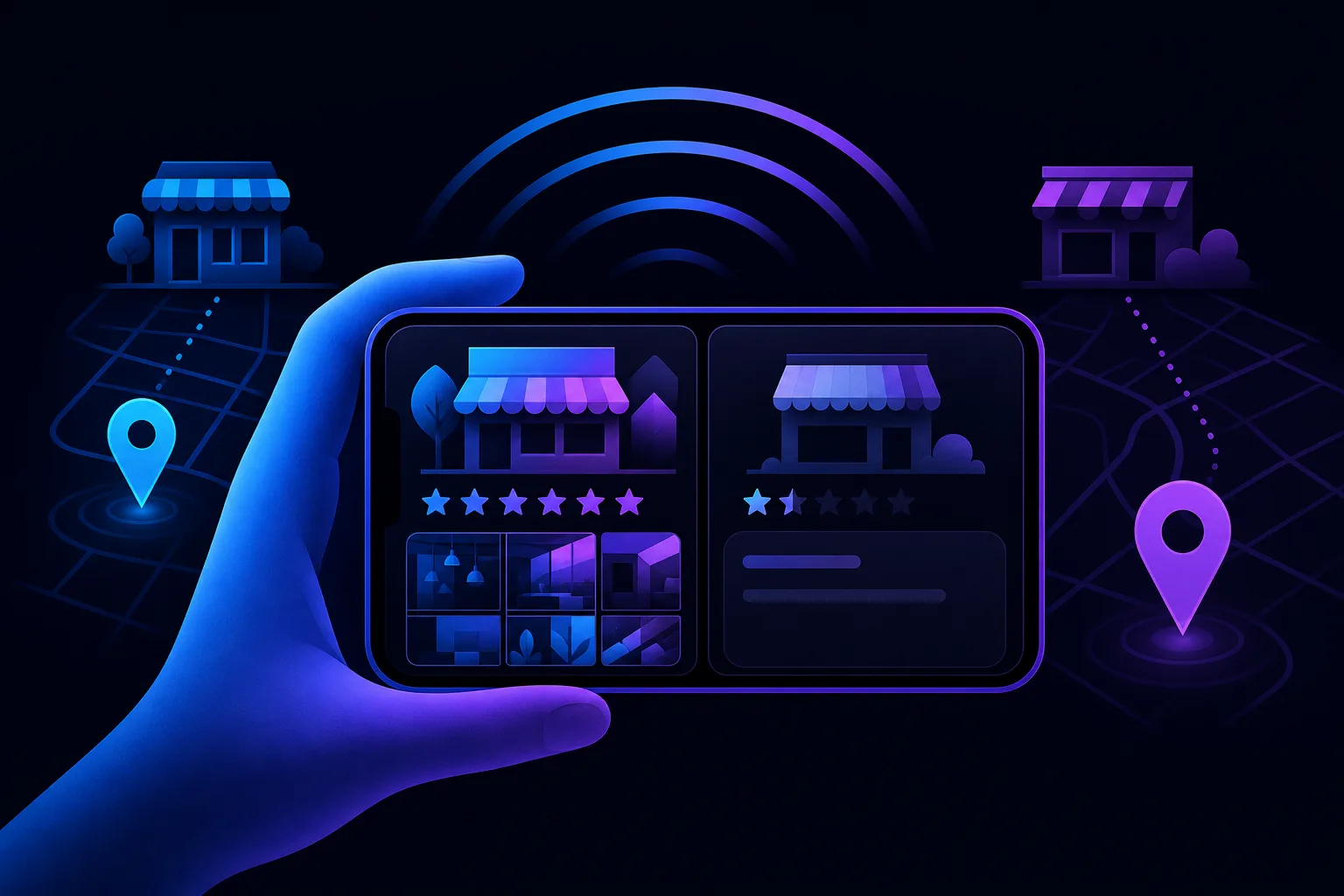
Searchers scan fast. They look at your photos, your review count and score, your hours, whether you answer common questions in your listing, and then they look at your website if they bother at all. If anything looks off compared to the competitor listing right next to yours, you lose.
Why It Matters
This is not a small problem. Local search observers consistently note that most people contact one of the first few businesses they evaluate and make that decision quickly, often before reading much at all. Every day you have this problem, you are paying for visibility and handing the revenue to someone else.
The causes tend to cluster into four buckets.
1. Your review profile looks thin or stale. A plumber with 11 reviews and a 4.2 rating loses to a plumber with 94 reviews and a 4.7, almost every time, even if the first plumber ranks higher. Recency matters too. Reviews from two years ago signal a business that stopped caring.
2. Your listing has friction or missing information. No photos, wrong hours, no services listed, no Q&A answered. Each missing element is a reason to doubt. A law office that lists no practice areas, no photos of the team, and no link to a website gives searchers nothing to trust.
3. Your website fails the five-second test. If someone clicks through to your site and it loads slowly, looks broken on mobile, or doesn't immediately confirm that you do the thing they searched for in the city they're in, they hit back and call the next result. This happens before they read a single sentence.
4. You are slower to respond than your competitor. Some calls don't happen because the customer sent a message first. If your GBP messaging goes to a phone that nobody checks, or if your contact form has no auto-reply, you lose the lead to whoever responded first. Speed is a conversion variable.
The compounding problem is that most business owners diagnose this as a ranking problem and chase higher positions. More visibility of a broken experience just produces more lost customers.
Find out what your site is leaving on the table Get your free audit
What We Don't Know Yet
Google does not tell you how many people viewed your listing and then called a competitor. GBP Insights shows clicks to call and direction requests, but it does not show abandonment. So the exact size of the gap is hard to measure directly.
What you can observe is the ratio of profile views to actions. If your listing gets hundreds of views per month but generates very few calls or clicks to website, the conversion problem is real and significant, even if you cannot see exactly where the searcher went next.
You also cannot know with certainty whether your competitor is winning on reviews, speed, website quality, or some combination. That requires a manual audit of their profile compared to yours, which is worth doing.
What to Do About It
Run this diagnostic sequence before changing anything else.
Step 1. Pull your GBP performance data. In your Google Business Profile dashboard, look at searches, profile views, and the actions taken (calls, website clicks, direction requests). Calculate your action rate: actions divided by views. As a rough rule of thumb in many categories, under 5 percent is a problem worth investigating, though what counts as normal varies significantly by industry.
Step 2. Search your own business category from a phone. Search "[your service] near me" or "[your service] [your city]" on a phone you are not logged into. Look at your listing the way a stranger would. Compare it honestly to the two or three competitors shown beside you. Count their reviews versus yours. Look at their photos versus yours. Check whether their hours are current.
Step 3. Load your own website on a phone with a slow connection. Time how long it takes to get a usable page. Check whether your phone number is tappable in the first screen. Check whether the page immediately says what you do and where. If a first-time visitor cannot confirm you are the right business within five seconds, the page needs work. See also the related problem with service pages that get traffic but generate no form submissions.
Step 4. Check your review velocity. How many reviews have you received in the last 90 days? If the answer is fewer than one per month, you are likely losing comparison shopping decisions to businesses that actively ask for reviews after every job.
Step 5. Test your own response time. Send a message to your own business through GBP or your website contact form. How long does it take to get a reply? If the answer is hours or never, that is a conversion leak.
Once you know where the gap is, the fixes are concrete. More reviews requires a system, not a one-time ask. Website speed and mobile usability are technical problems with technical solutions. GBP completeness is an afternoon of work. Response time is a process problem, often solved with a simple auto-reply or by enabling notifications you had turned off.
If you want an outside read on where your biggest gap is, the free AI readiness audit at SmartAleck looks at your overall digital presence and surfaces the specific weak points. If the site itself is the culprit, web design built for local conversion is a more direct path than continuing to patch it yourself.
The one-line version: Ranking gets you found. Everything after the click determines whether you get the call, and that is entirely within your control.
Find out what your site is leaving on the table
SmartAleck's free AI readiness audit scores your search presence and shows the exact gaps costing you customers. Two minutes, no sales call.
Frequently asked questions
Does a higher Google ranking automatically mean more calls?
Not reliably. Ranking determines whether your listing appears, but the call decision depends on what searchers see when they compare you to competitors: reviews, photos, hours, and how your website performs. A lower-ranked competitor with more reviews and a faster site can easily win the call.
How many Google reviews do I need to be competitive?
There is no universal threshold, but you need to be in the same range as the competitors showing up beside you in your specific market. A repair shop competing in a metro area may need 80 to 100 reviews; the same shop in a small town may compete well with 25. Check what the top two or three local results have and use that as your benchmark.
What is a reasonable action rate on a Google Business Profile?
Action rate is the percentage of profile views that result in a call, website click, or direction request. Benchmarks vary significantly by industry and no single authoritative standard applies across the board, so treat any number as an illustrative estimate rather than a hard target. As a rough reference point, anything under 3 to 5 percent in many categories is worth investigating, while a well-optimized listing in a competitive category may perform meaningfully higher, though your own trend over time is often more useful than any external benchmark.
Can a slow website cause me to lose calls even if my GBP is strong?
Yes. Many searchers click through to a website before deciding to call, especially for higher-consideration purchases like legal services or home improvement. If the site loads slowly on mobile or does not immediately confirm your service and location, visitors leave and call the next result.
You May Also Like
View All Posts
Competitor Outranking You on Google Maps? Fix It
When a competitor camps out above you in the Google Maps 3-pack, it's rarely luck. It's a checklist you haven't finished. Here's how to diagnose the gap and close it, step by step.

Why Ranking #1 on Google Doesn't Always Mean More Leads
Hitting the top of Google is a milestone, not a finish line. A #1 ranking can still produce zero leads if the wrong people are clicking, your page doesn't convert, or search results have changed around you. Here's what actually drives leads.
Why Your Competitors Rank in Cities They Don't Have Offices In
Your competitor shows up in search results for cities where they have no office, no storefront, and possibly no customers yet. This isn't magic or cheating. It's a specific set of tactics, and once you know them, you can use them too.
Why Your GBP Photos Get Views but Your Profile Gets No Calls
High photo views on your Google Business Profile feel like progress, but they mean almost nothing if nobody calls. The real problem is usually a mismatch between what your photos promise and what the rest of your profile delivers. Here's how to diagnose it.