Why Your Competitors Rank in Cities They Don't Have Offices In
Your competitor shows up in search results for cities where they have no office, no storefront, and possibly no customers yet. This isn't magic or cheating. It's a specific set of tactics, and once you know them, you can use them too.
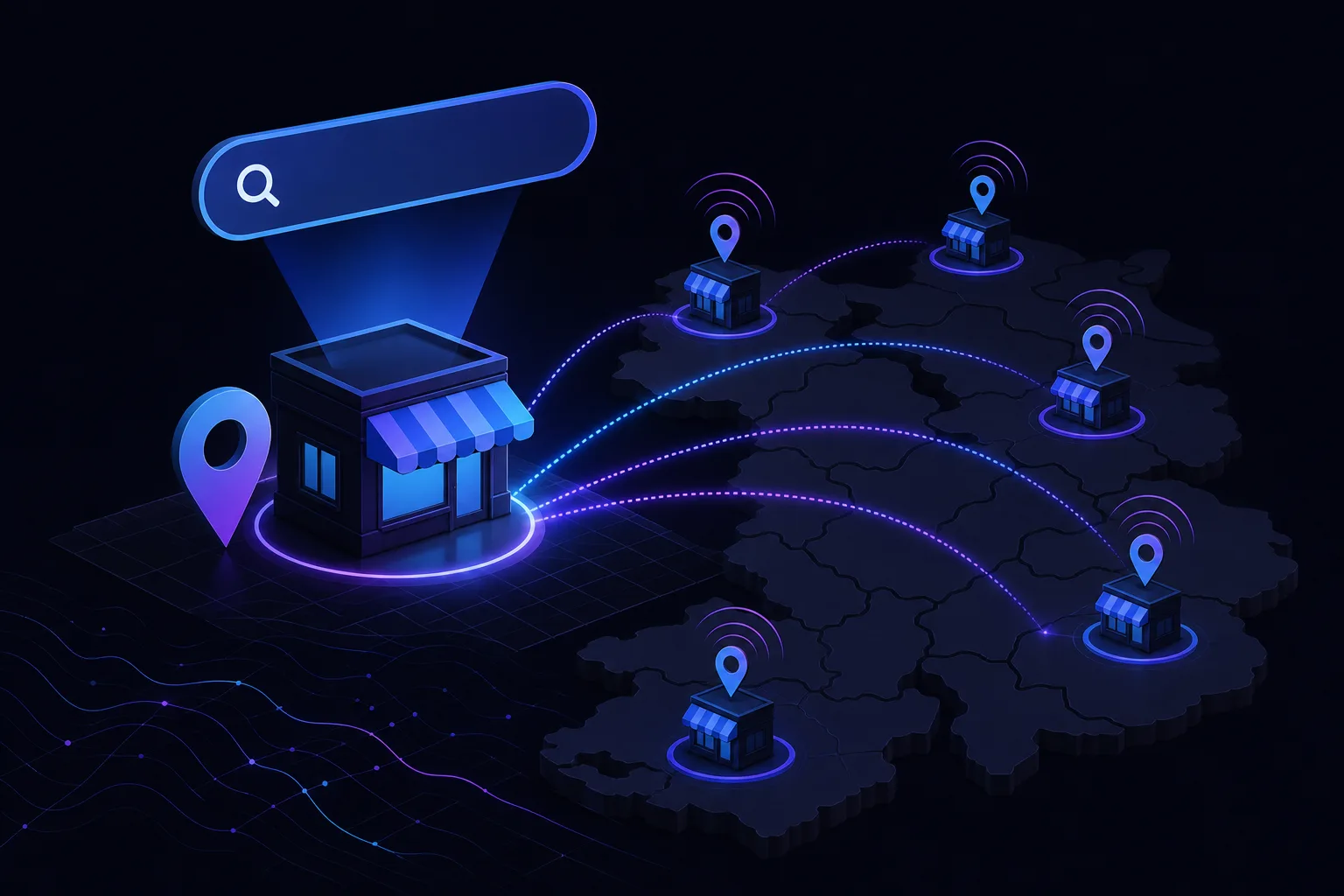
TL;DR: Competitors rank in cities they don't occupy by publishing geo-targeted content, building location-specific signals across the web, and in some cases using Google Business Profile service areas strategically. None of this requires a second office. All of it requires intentional effort.
What Happened
You searched your service category in a nearby city, expecting to see local businesses from that area. Instead, you saw a competitor from your city, or even from across the state, sitting near the top of organic results. No branch office there. No local phone number. Just a well-positioned website eating your potential customers.
This happens constantly in service industries: HVAC companies, personal injury law firms, pest control operators, roofing contractors. The businesses showing up aren't necessarily bigger or better. They just understand how Google decides what's "local" for organic search results versus the Local Pack (the map listings).
The distinction matters. The Local Pack (map results with pins) is heavily tied to physical location proximity. If your competitor has no address in that city, they mostly can't win a map placement there. But organic blue-link results and even some AI-generated answer summaries don't require a nearby address. They reward relevance and authority signals, which you can build from anywhere.
Why It Matters
Google's local ranking systems aren't one system. They're several, layered on top of each other. Knowing which layer your competitor is winning, and how, tells you exactly what to fix.
Location Pages That Actually Contain Useful Information
The most common tactic is a dedicated landing page for each target city. A plumber based in Fort Lauderdale creates a page titled "Plumber in Boca Raton" that actually discusses Boca Raton, mentions local neighborhoods, references common pipe problems in older homes there, and includes a local phone number (even a call-forwarded one).
Google can read that page. If it's genuinely useful and the domain has authority, it can rank for queries in that city.
The pages that don't work are the ones that swap one city name into a template and call it done. Google has gotten much better at identifying thin, duplicated location pages. A page that says "We are the best plumber in Boca Raton. Call us for plumbing in Boca Raton. We serve Boca Raton." is not a local page. It's spam with a city name.
Takeaway: A location page earns its ranking by containing genuinely city-specific information, not by repeating the city name.
Consistent NAP Citations in the Target City
Name, Address, Phone (NAP) citations on directories, local chamber pages, and niche sites tell Google's systems that a business operates somewhere. A service-area business can list a target city in its service area on Yelp, Angi, Thumbtack, and similar platforms without having a physical address there.
This doesn't create a map pin, but it does contribute to the entity profile Google builds for a business, essentially its understanding of who you are, where you operate, and what you do. Stronger entity profiles help with both organic and AI-driven answer results.
For a deeper look at how entity signals work, see What Is Entity SEO and Why Local Businesses Need to Care.
Takeaway: Citations in a target city reinforce your entity signals without requiring a lease.
GBP Service Areas (Used Correctly)
Google Business Profile lets service-area businesses list up to 20 service areas. A competitor who has correctly set their service areas can appear in Local Pack results for those areas, though typically with lower placement than a business physically located there.
This is the same mechanism discussed in Why Your GBP Ranking Changes by Zip Code and in the proximity bias explainer. Distance from the searcher still matters. But in lower-competition markets, or when the nearest competitor has weak signals, a well-optimized service-area GBP can still surface.
Takeaway: Service area settings are not a workaround for proximity, but they're not irrelevant either.
Backlinks From Local Sources in the Target Area
A link from the Boca Raton Chamber of Commerce, a Boca Raton news site, or a local sponsor page tells Google that a business has a real relationship with that community. These links carry local relevance signals that generic directory links don't.
This is slower to build and harder to fake, which is exactly why it works.
Takeaway: Local backlinks are the hardest signal to replicate and the most durable.
Find out what your site is leaving on the table Get your free audit

What We Don't Know Yet
Google hasn't published a clean rulebook for multi-city organic rankings, and it changes its weighting of signals regularly. A few things remain genuinely uncertain:
- How much weight AI-generated results (like AI Overviews) give to location-specific content versus general authority. Early evidence suggests entity clarity matters a lot, but specific local signals may matter less than in traditional results.
- Whether virtual office addresses or co-working space listings violate GBP guidelines in practice. Google's policy says the address must be staffed during listed hours. Enforcement is inconsistent.
- How many location pages is too many before Google treats your site as a thin-content farm. There's no official number. The practical answer is: as many as you can make genuinely distinct.
What to Do About It
Here's a diagnostic sequence. Work through it in order before spending money on anything.
- Search your service plus each target city in an incognito window. Note whether your competitor appears in the Local Pack or in organic results. Those are different problems with different solutions.
- Pull their location pages. Use a free tool like Screaming Frog or just search
site:competitordomain.com [city name]. How many city-specific pages do they have? Are they substantive or thin? - Check their GBP service areas. Find them on Google Maps, click their listing, and look at the service area. Are your target cities listed?
- Look for local backlinks. Search
[competitor name] site:[targetcity].comor use a free backlink checker like Ahrefs' free version. Are they getting links from local sources you're not? - Compare your own location content. Do you have a page for each city you want to rank in? Does each one say something genuinely different?
If you want to know how well your current setup positions you for both traditional local search and newer AI-driven results, the free AI readiness audit at SmartAleck covers both. The geo-targeted SEO service is worth a look if you're trying to expand your footprint into multiple markets without opening multiple offices.
Self-help is appropriate here if you have time to create real content for each target city and the patience to build citations methodically. Professional help makes sense when you have multiple target cities, an existing site with technical issues, or a competitor who has a 12-month head start and you need to close the gap faster.
Find out what your site is leaving on the table
SmartAleck's free AI readiness audit scores your search presence and shows the exact gaps costing you customers. Two minutes, no sales call.
Frequently asked questions
Can a business rank in the Local Pack (map results) for a city where it has no address?
Rarely, and it's hard to sustain. The Local Pack heavily weights proximity to the searcher. A service-area business can appear there if competition is thin and their GBP service areas are set correctly, but a business with a physical address in that city will almost always outrank them for nearby searches.
Are city-specific landing pages considered spam by Google?
Thin, duplicated pages that just swap out a city name are treated as low-quality content and can actually hurt your site. Pages that contain genuinely different, city-specific information, local context, specific services relevant to that area, are legitimate and can rank well. The distinction is substance, not format.
How many service areas can I list on my Google Business Profile?
Google allows up to 20 service areas on a GBP listing. Adding cities doesn't guarantee you'll rank there, but it does register those areas with Google's systems and can improve visibility for searchers in lower-competition markets.
Does having a local phone number for a city help with rankings there?
A local area code on a city-specific landing page is a minor relevance signal, and it improves conversion rates because it looks familiar to local callers. It's not a major ranking factor on its own, but combined with strong content and citations, it contributes to a more credible local presence.
You May Also Like
View All Posts
Competitor Outranking You on Google Maps? Fix It
When a competitor camps out above you in the Google Maps 3-pack, it's rarely luck. It's a checklist you haven't finished. Here's how to diagnose the gap and close it, step by step.
Google Maps But Not Search Results? Here's Why
A business can appear on Google Maps while its website has little organic search visibility. Use Search Console to check indexing, queries, page relevance, and competition before choosing a fix.
How to Do a Competitor SEO Analysis in One Afternoon
You don't need a $3,000 audit to figure out why a competitor outranks you. Here's a practical, four-hour sequence using free tools to find the gaps you can actually fix this quarter.
Why Your GBP Ranking Changes by Zip Code
Your Google Business Profile doesn't have one ranking. It has dozens, one for every neighborhood, zip code, and street corner where someone searches. Proximity to the searcher is the biggest single factor, and that changes constantly. Here's what's happening and what to do.