Single-Location vs Multi-Location SEO: How Strategy Changes
One Google Business Profile or twenty? The gap between single-location and multi-location SEO isn't just about scale. The strategy, the structure, and the mistakes are fundamentally different. Here's a plain-English breakdown of what actually changes.
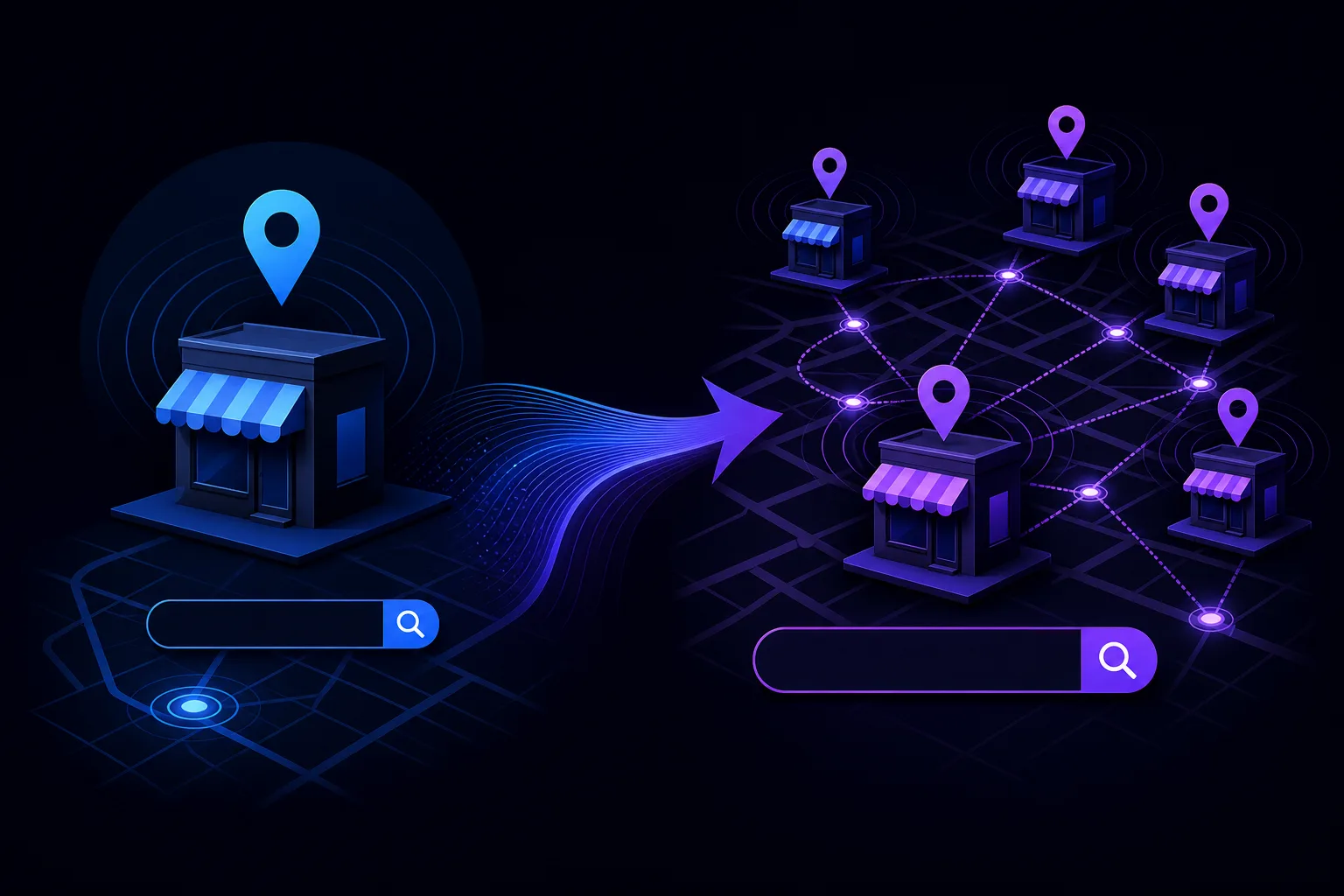
TL;DR: Single-location SEO is about dominating one service area with one authoritative local presence. Multi-location SEO multiplies that challenge by N locations, adds internal competition risks, and demands a completely different site architecture. Get the structure wrong early and you pay for it for years.
At a Glance
| Factor | Single-Location | Multi-Location |
|---|---|---|
| Google Business Profiles | One | One per location |
| Landing pages needed | One local page (often homepage) | Dedicated page per location |
| NAP consistency risk | Low | High, grows with each location |
| Internal competition risk | None | Significant if pages aren't differentiated |
| Citation building | One set of directories | Separate citations per location |
| Review strategy | Centralized | Split across profiles |
| Complexity | Moderate | High to very high |
| Biggest mistake | Ignoring local signals | Cannibalizing your own rankings |
What Single-Location SEO Actually Looks Like
If you run a single plumbing business in Fort Lauderdale, your SEO problem is pretty well-defined. You need to rank in the local map pack and organic results for searches like "plumber Fort Lauderdale" and related terms. One city. One service area. One Google Business Profile.
That simplicity is a gift. You can focus every signal, every review, every backlink, and every piece of content on one location. There's no question about which page to optimize for which city. There's no internal debate about whether your Boca Raton page is stealing traffic from your Delray Beach page.
The core tasks for a single-location business:
- Google Business Profile. Fully built out, posted to regularly, and reviewed consistently. How often you post matters more than most owners think.
- NAP consistency. Your name, address, and phone number need to match everywhere online. One wrong suite number across 40 directories is enough to create friction. This is what NAP consistency actually means for local SEO.
- Local landing page. Usually your homepage, sometimes a dedicated page. City name, neighborhood references, schema markup, and locally relevant content.
- Reviews. A steady stream of them. Not a one-time push. Getting more Google reviews without being annoying is a real skill.
- Citations. The major directories: Google, Yelp, Apple Maps, Bing Places, and a handful of industry-specific ones.
The failure mode for single-location businesses is neglect, not complexity. They set up the GBP once in 2021, never touch it, get outreviewed by a competitor who just opened, and wonder why they slipped. The fix is usually straightforward.
Takeaway: Single-location SEO rewards consistency more than cleverness.

What Multi-Location SEO Actually Looks Like
Now add a second location. Then a third. The strategy doesn't just double or triple. It changes in kind.
A law firm with offices in Miami, Orlando, and Tampa isn't just doing the same thing three times. They're managing three separate local presences that can compete with each other in certain queries, three GBP profiles with three separate review pools, and a website that needs to serve users and search engines across all three markets without confusing either.
Here's where the complexity compounds.
Site Architecture Is Non-Negotiable
The most critical decision in multi-location SEO is how you structure your website. The standard approach is dedicated location pages, each living at a consistent URL pattern like /locations/miami/ or /miami-family-law/.
Each page needs to be genuinely different. Not "same page, city name swapped." Google is very good at identifying thin, templated location pages and simply ignoring them. If your Miami page and your Orlando page have identical content except for the city name, you've created duplicate content that dilutes ranking signals instead of concentrating them.
What makes a location page actually work:
- Local team bios or photos from that office
- Location-specific testimonials or case results
- References to local landmarks, courts, or neighborhoods
- Unique FAQs based on questions that location's customers actually ask
- A locally embedded Google Map and that location's specific GBP information
One GBP Per Location, Managed Separately
Google requires, and rewards, separate Google Business Profiles for each physical location. That means separate verification, separate review management, separate photo uploads, and separate post schedules.
This is where multi-location businesses often cut corners. They treat GBP management as a once-and-done setup instead of an ongoing channel. The location that gets the most attention usually wins the most local map pack visibility. The neglected ones drift.
If you have five locations and only one person managing all five GBP profiles part-time, the math doesn't work.
Keyword Cannibalization Is a Real Problem
If your Tampa page and your Orlando page are both optimized for "family law attorney Florida," they're competing against each other. Neither page sends a clean, concentrated signal. Google has to pick one, often picks neither, and a competitor with a single well-optimized page beats you.
The fix is geographic specificity. Tampa gets "family law attorney Tampa." Orlando gets "family law attorney Orlando." You also need to think carefully about which pages you internally link to for which anchor texts. Sending links with generic statewide anchor text to five different location pages splits the signal five ways.
This is one of the more technical parts of multi-location SEO. If you're not sure whether you have a cannibalization problem, checking Google Search Console is a good starting point.
Citation Management Becomes a Real Job
For a single location, keeping citations consistent is manageable. For ten locations, it's a part-time job. Every location needs its own set of directory listings. Each listing needs to match the GBP exactly. When you move a location, rename it, or change the phone number, you're not updating one listing. You're updating dozens.
Tools exist to automate citation management. They're worth the cost at scale. Doing it manually across ten or more locations is how errors accumulate quietly until a citation audit reveals a mess.
Takeaway: Multi-location SEO fails at the architecture and management layer, not the keyword layer.
Find out what your site is leaving on the table Get your free audit
The Tradeoffs You're Actually Choosing Between
Control vs. scale. Single-location SEO gives you tight control over every signal. Multi-location SEO requires you to systematize and delegate. If your process depends on one person who "just knows" how the site works, that breaks badly when you open location three.
Depth vs. breadth. A single-location business can go very deep on one market. A multi-location business has to balance depth across markets. Often the best approach is building a strong local page template and then layering in genuine local differentiation rather than trying to custom-build every location page from scratch.
Review velocity. A single location that gets 50 reviews a month looks authoritative. Fifty reviews split across five locations is ten per location, which is much weaker individually. This matters for map pack rankings, which factor in review quantity and recency. Multi-location businesses often need to run location-specific review campaigns rather than one central push.
Budget allocation. Where do you spend? The answer is almost always: your highest-revenue or highest-potential location first. A common mistake is spreading budget evenly across all locations and getting mediocre results everywhere instead of strong results somewhere.
If you're trying to figure out which approach fits your current situation, a quick look at your existing performance data usually makes the priority clearer.
What Stays the Same Regardless of Location Count
Not everything changes. A few fundamentals apply whether you have one location or twenty:
- Technical site health matters. Page speed, mobile usability, crawlability. These aren't local issues, they're foundational. You can check where you stand with a free domain health check.
- Content still needs to answer real questions real customers ask. That doesn't change with scale.
- Links from locally relevant sources still carry weight. A mention in the Orlando Business Journal helps your Orlando location. It doesn't help your Tampa location much.
- Patience. Local SEO timelines don't compress just because you have more locations.
Verdict
Single-location SEO is a focus problem. Multi-location SEO is a systems problem.
If you have one location, your job is to build the strongest possible local signal in one market and keep it maintained. Most single-location businesses underperform because they set things up once and walk away, not because the strategy is complicated.
If you have multiple locations, your job is to build a structure that works at scale without cannibalizing itself. Dedicated location pages with real differentiation, separate GBP profiles managed actively, geographically specific keyword targeting, and a citation management process that doesn't depend on memory.
The single biggest mistake people make when growing from one to multiple locations is treating it as a copy-paste operation. It isn't. The second location is where the strategy has to mature.
If you're not sure where your current setup stands, a free AI readiness audit will show you quickly where the gaps are, whether you're running one location or ten. And if you want someone to map out the full approach for your situation, that's what we're here for.
Find out what your site is leaving on the table
SmartAleck's free AI readiness audit scores your search presence and shows the exact gaps costing you customers. Two minutes, no sales call.
Frequently asked questions
Do I need a separate Google Business Profile for each location?
Yes. Google requires a separate GBP for each physical location, and each one needs to be verified independently. Trying to manage multiple locations under one profile leads to errors, suppressed listings, and lost map pack visibility. Treat each profile as its own ongoing channel.
What should each location page on my website include?
Each page needs genuinely unique content: local team info, location-specific reviews or results, references to the actual neighborhood or city, and that location's specific contact information with a locally embedded map. Pages that just swap the city name on a template get treated as thin content by Google and rarely rank.
How do I avoid keyword cannibalization across multiple location pages?
Target location-specific keywords on each page rather than broad statewide or generic terms. Your Miami page targets Miami-specific queries; your Tampa page targets Tampa-specific queries. Also audit your internal linking to make sure you're not pointing generic anchor text to multiple competing pages.
Is it better to start local SEO for all locations at once or one at a time?
Usually one at a time, starting with your highest-revenue or highest-potential location. Spreading budget thinly across all locations tends to produce mediocre results everywhere. Building a strong foundation in one market, then rolling out the same structure to the next, is more sustainable and easier to learn from.
How does review management change with multiple locations?
With multiple locations, your reviews are split across separate GBP profiles, so the quantity and recency signals are weaker per location. You'll need location-specific review campaigns rather than one central effort. Customers who visit a specific location should be directed to leave a review on that location's profile.
When does multi-location SEO require professional help?
When you hit more than two or three locations, the citation management, site architecture decisions, and GBP maintenance load usually exceed what one person can handle well on top of running a business. At that point, systematic tooling or outside help isn't a luxury. Errors at scale compound quietly and are expensive to fix later.
You May Also Like
View All Posts
How Often Should a Small Business Post to Google Business Profile
Posting to your Google Business Profile matters, but more is not always better. This guide gives you a realistic schedule, explains what types of posts do actual work, and tells you exactly what to skip so you stop wasting time on content nobody sees.

Local SEO vs Paid Ads: Where to Spend First
Compare local SEO and paid ads by setup, ongoing costs, speed, and qualified leads. This guide shows when each channel can help a small business.

Google Business Profile Optimization Checklist (2026)
Your Google Business Profile is often the first thing a local customer sees before your website. This checklist walks you through every section, in order, so nothing gets skipped and your listing actually does its job.
Why Your GBP Description Isn't Helping You Rank
Your Google Business Profile description feels important, but Google has confirmed it carries little ranking weight. The fields that actually move the needle are categories, reviews, and your website's on-page signals. Here's where to spend your time instead.