Local SEO vs Paid Ads: Where to Spend First
Compare local SEO and paid ads by setup, ongoing costs, speed, and qualified leads. This guide shows when each channel can help a small business.
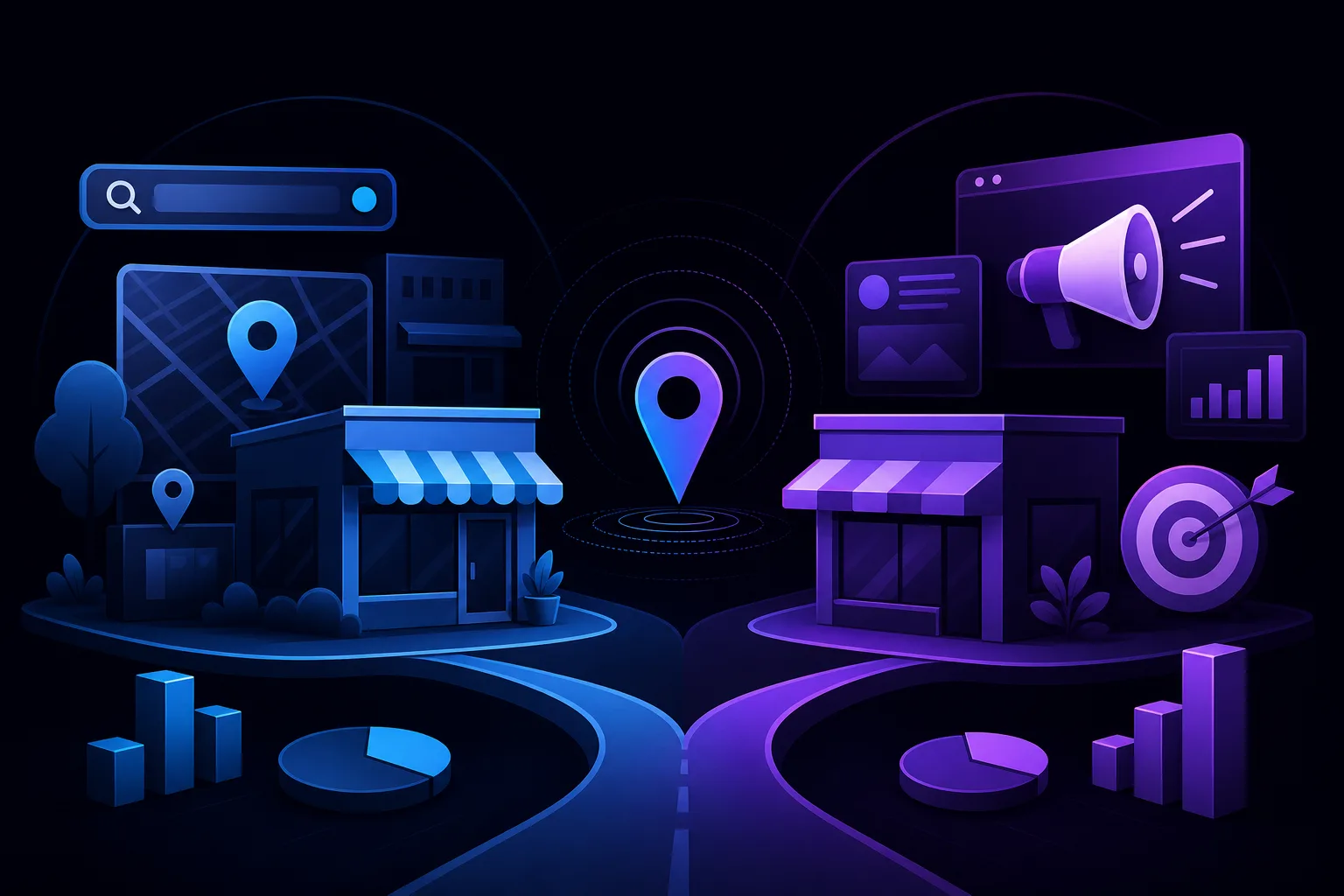
TL;DR: Many small businesses benefit from a solid Business Profile and useful website before scaling paid ads. Ads can also be useful early when time-sensitive demand justifies the spend. Compare both channels by qualified leads and cost.
At a Glance
| Local SEO | Paid Ads (Google/Meta) | |
|---|---|---|
| Cost structure | Setup and ongoing maintenance | Campaign setup and ongoing spend |
| Speed to results | Varies by market and work | Can start quickly after approval |
| Longevity | Can persist but needs maintenance | Traffic generally stops when spend stops; learnings can remain |
| Best for | Sustainable lead flow | Immediate demand, promotions |
| Skill required | Moderate | Moderate to high |
| Risk | Slow start frustrates owners | Easy to burn cash with no ROI |
What "Local SEO" Actually Means Here
Local SEO is not one magic lever. It is the combination of your Google Business Profile, your website's on-page signals, local citations, reviews, and the content that tells Google exactly who you serve and where. When a homeowner in your city searches "emergency plumber near me" and taps one of the three results in the map pack, that is local SEO doing its job.
The work involved: claiming and filling out your Google Business Profile completely, building consistent NAP (name, address, phone) citations across directories, earning real reviews, and publishing service-area pages that actually say something useful. Check out how to rank in Google's local map pack for the full tactical breakdown.
The payoff is not instant. Organic visibility can persist without a per-click charge, though rankings change and the work needs maintenance.
Takeaway: Local SEO is an asset. Paid ads are a lease.

What Paid Ads Are Actually Good At
Google Search ads and Meta ads do one thing extremely well: they put you in front of people right now. A personal injury law firm that just opened cannot wait six months for organic traction. A restaurant running a Father's Day special needs eyeballs this week, not next quarter.
Paid ads also let you test messaging fast. Run two headlines, see which one gets clicked, and apply that knowledge everywhere else. That is genuinely useful.
But here is what the ad platforms are not good at: building anything that lasts. Ad-driven traffic usually stops when the campaign stops, though the campaign can produce customer relationships and useful performance data.
Compare the actual cost per qualified lead and customer from each channel. A sample budget alone cannot predict conversion rate, lead cost, or the return from a year of SEO.
Takeaway: Ads buy attention. SEO earns it.
The Case for SEO First
Most small businesses do not have an ad budget that survives contact with reality. Keyword click costs vary by location, competition, match type, and campaign setup. Use current Google Ads estimates for your own target market before setting a budget; clicks alone are not customers.
Local SEO, by contrast, builds on itself. A service-area landing page that ranks well does not stop working when the month ends. Genuine reviews remain visible unless removed under platform policy, but their effect on future customers varies. A properly structured Google Business Profile keeps earning impressions around the clock.
There is also a trust signal difference. Some customers prefer organic or map results, while others click ads. Measure your own lead quality and conversion rate instead of assuming one result type always wins.
See local service landing pages that convert for exactly how to structure those pages so the traffic you earn actually turns into calls.
Takeaway: SEO wins on compounding returns. Ads win on speed.
Find out what your site is leaving on the table Get your free audit
When Paid Ads Should Come First
There are legitimate situations where ads deserve the first dollar.
You need to test lead generation on a short timeline. A new business with no pipeline can test targeted ads while building its website and Business Profile. Run tight, well-targeted local search ads to get initial clients, use those clients to generate reviews, and let the SEO build in parallel.
Your category is purely transactional and high-urgency. Locksmith, towing, emergency plumber. These searches happen in a moment of panic and the person clicks the first thing they trust. A solid map listing helps here too, but ads can capture overflow.
You are promoting a time-sensitive offer. A repair shop running a summer tire deal does not need that to rank organically. Spend $300 on targeted ads, run for two weeks, done.
Your SEO is already solid and you want to scale. This is actually the ideal setup. Once your organic presence generates predictable baseline leads, ads become incremental. You are not paying to compensate for invisibility. You are amplifying from a position of strength.
Takeaway: Ads may make sense for time-sensitive demand, launches, or proven profitable campaigns.
The Budget Allocation Question
A common question: if I have $1,000 a month for marketing, how do I split it?
Here is a practical framework, not a magic formula.
If your Business Profile and website are incomplete, fix them before sending significant paid traffic to the site; there is no universal ten-review threshold. Those assets need ongoing accuracy and maintenance. Running ads into a broken foundation just accelerates wasted spend.
Once the foundation is solid, test an allocation based on your actual lead costs, capacity, and time horizon; a 70/30 split is not a general benchmark. For example, a business testing a $1,000 monthly budget might put $700 toward ongoing SEO work and $300 toward a tightly targeted ad campaign. That is an illustration, not a recommended split; choose amounts from your own lead costs and capacity.
As SEO gains momentum and organic leads become consistent, you can shift ratios or increase total budget. The point is not the exact split. It is that you are building something instead of just renting.
If you want a clearer picture of where your current setup actually stands, the free AI readiness audit gives you a fast baseline without the sales call.
Takeaway: Fix the foundation before you pay per click.
The Hidden Costs People Forget
Local SEO has a real cost: time and sometimes professional help. A business owner trying to DIY everything while also running the business often does it halfway, which produces half the results. Poorly written service pages, duplicate citations, and an abandoned Google Business Profile are not free, they are expensive in opportunity cost.
Paid ads have an even sneakier hidden cost: learning tax. A new campaign can waste money through poor targeting or tracking. Review search terms, match types, conversion data, and landing pages before increasing spend. That is not a criticism. It is just how the platform works before you know what you are doing. See the case studies for examples of what managed campaigns look like when the fundamentals are right.
Both channels reward competence. Neither rewards wishful thinking.
Takeaway: The cheap option is whichever one you can actually execute well.
A Word on Tracking
None of this conversation matters if you cannot tell what is working. Before scaling either channel, set up practical lead tracking, such as form and call attribution where appropriate. Without attribution, you are guessing.
This is where small businesses lose money in both channels. They run ads, get some calls, cannot tell which calls came from ads, and either over-credit or under-credit the channel. Same thing happens with SEO. You cannot optimize what you are not measuring. The free marketing tools at SmartAleck include resources to help you get this right without hiring a data analyst.
Takeaway: Attribution is not optional. It is how you stop guessing.
Verdict
For most small businesses, the answer is: local SEO first, paid ads second.
Build an accurate Business Profile, invite genuine reviews, publish useful service pages, and correct wrong listings. Monitor qualified leads over time; no fixed timeline or lead volume is guaranteed.
Then, once that foundation exists, layer in paid ads selectively. Use them for new service launches, seasonal pushes, or to accelerate growth in a competitive category where you want faster momentum.
The only exception is when you are genuinely cash-flow constrained right now and need leads this week. In that case, run tight, targeted local search ads, but do not confuse that with a long-term strategy.
Want to know which gaps in your local presence are costing you the most right now? Start with the free AI readiness audit and get a real baseline in minutes.
Find out what your site is leaving on the table
SmartAleck's free AI readiness audit scores your search presence and shows the exact gaps costing you customers. Two minutes, no sales call.
Frequently asked questions
Is local SEO or Google Ads better for a brand-new small business?
If you have zero organic presence and need leads now, a tight Google Ads campaign can bridge the gap while your SEO builds. But do not skip the SEO fundamentals. Claim your Google Business Profile, get your first reviews, and build service-area pages in parallel so you are not renting traffic forever.
How long does local SEO take to show results?
It depends on your market competition and how well the work is done, but timing varies widely; use your own baselines and review progress over several months. Highly competitive categories like personal injury law or HVAC in a major city can take longer. The upside is that results compound rather than reset each month.
Can I run local SEO and paid ads at the same time?
Yes, and that is often the best long-term setup. SEO may contribute organic leads while ads can test seasonal offers, new services, or coverage gaps; compare actual lead costs. Make sure the ad destination and tracking work before increasing spend.
How much should a small business spend on local SEO per month?
There is no universal number, but the useful budget depends on competition, scope, and what work the business can do itself. The real question is whether the return justifies the spend, which requires proper tracking of leads by source.
Why do some businesses rank in Google Maps but not in regular search results?
Google treats map pack rankings and organic web rankings as separate signals. Business Profile details help local visibility, while website pages matter for organic results; Google uses many signals for each. A business with a strong GBP but a weak website can rank in maps without appearing in organic results. You generally want both working together.
What is the biggest mistake small businesses make with paid ads?
Running ads without useful lead tracking. If you cannot tell which clicks became customers, you have no idea whether the campaign is profitable, and you cannot improve it. Set up call tracking and form tracking before you spend your first dollar on ads.
You May Also Like
View All Posts
Google AI Overviews: How to Keep Earning Clicks in 2026
Google AI Overviews can answer questions and link to sources. Learn how to measure their effect on your own search traffic and keep publishing useful local and service content.
How to Rank in Google's Local Map Pack (Step by Step)
Google’s local results consider relevance, distance, and prominence. This guide shows practical steps to improve your Business Profile, earn genuine reviews, and keep business details accurate.
Google Ads for Local Services: A Starter Playbook
Google Ads can send paying customers to your door fast, or drain your budget on clicks that never convert. This playbook shows local service businesses exactly how to set up, target, and optimize campaigns that actually work.

Internal Linking for Local SEO: How to Structure Your Site Pages
Internal linking tells Google which pages matter most on your site and helps visitors find what they need. For local businesses, a smart link structure moves authority from your homepage to your service and location pages, where rankings actually pay off.