Why Your Local Landing Page Ranks but Still Loses to a Directory
Ranking on page one should be enough. But directories like Yelp, Angi, and HomeAdvisor routinely sit above or beside local landing pages and scoop the clicks. The reason is structural, not algorithmic, and you can do something about it.
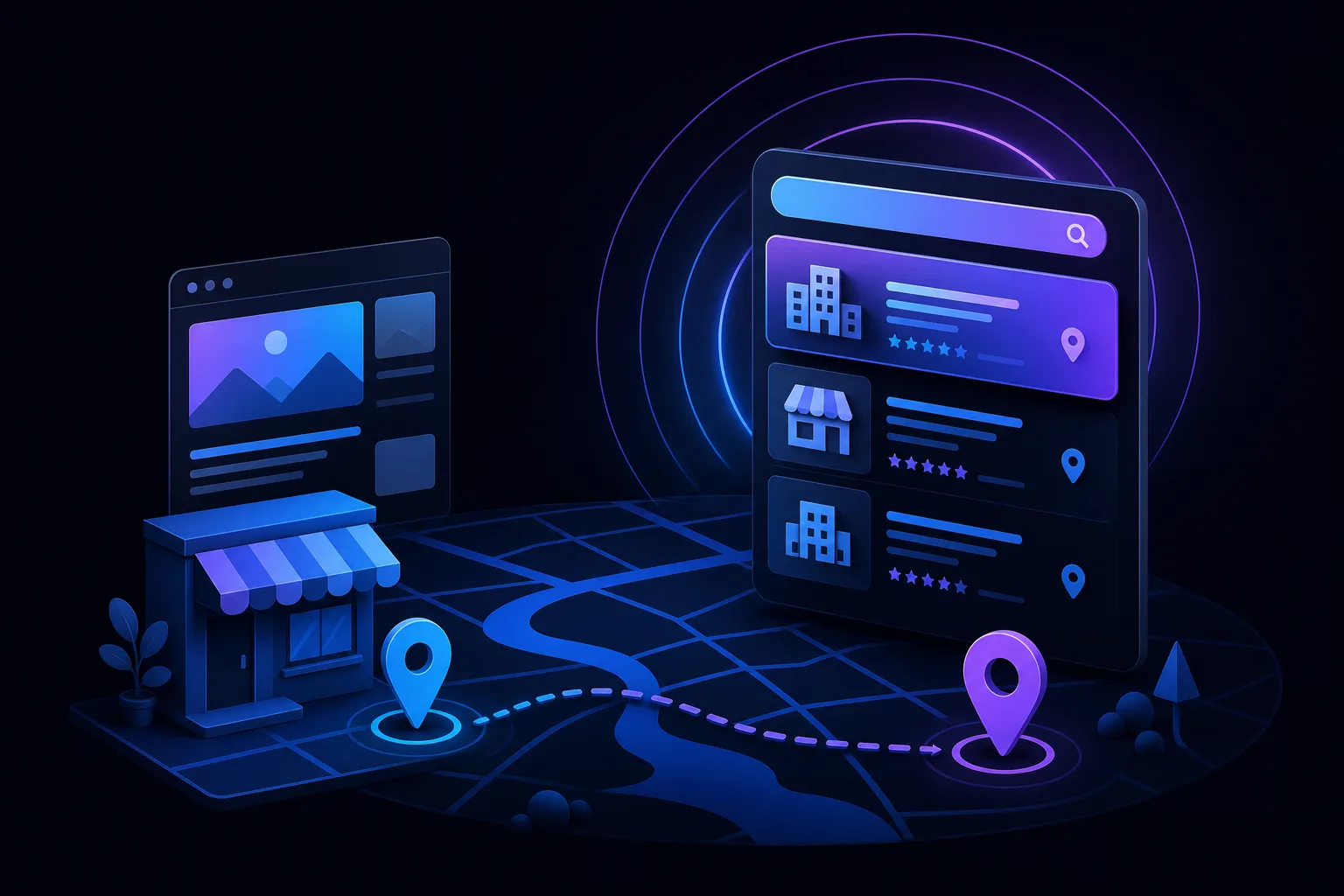
TL;DR: Your local landing page can rank on page one and still lose clicks to directories because directories carry more trust signals, richer SERP features, and broader review volume than most small-business pages can match solo. The fix is not to abandon your page. It is to understand what directories have that you do not, then close the gap selectively.
What Happened
Open an incognito tab and search for something like "plumber in Fort Lauderdale" or "family law attorney West Palm Beach." Count the results before you see a standalone business website. You will probably scroll past a map pack, one or two Yelp listings, an Angi card, maybe a FindLaw or Avvo result, and then, finally, a law office's own page.
This is not a glitch. It is the predictable output of how Google weighs competing signals at the same keyword.
Your landing page may be well-optimized. It may have the city name in the title tag, a decent backlink profile, and a fast load time. And it still finishes fourth or fifth in the organic list because the directory sitting above it has things your page structurally cannot replicate on its own.
Why It Matters
Rankings are a means to an end. Clicks are the actual currency. A position-four result gets significantly fewer clicks than a position-one result, according to various clickthrough-rate studies. Losing those clicks to a directory is especially painful because the directory then charges you for the same lead, or worse, sends it to a competitor listed on the same page.
Understanding why the directory wins helps you decide where to spend your effort.
Here is what directories have that your page typically does not:
Domain authority at scale. Yelp.com has millions of backlinks and decades of trust signals baked in. Your "plumber-miami.html" page is inheriting authority from your root domain, which is probably far smaller. Google treats domain-level trust as a proxy for page-level trustworthiness, so the directory starts with a structural lead before a single word is read.
Aggregated review signals. A directory listing shows star ratings in the SERP snippet. Those rich snippets pull the eye before a user even reads your title. Your standalone page can show review stars too through structured data markup, but only if you have enough reviews and have implemented the schema correctly.
Breadth of internal linking. A Yelp category page for "plumbers in Miami" is linked from thousands of other Yelp pages, from blog posts, from press articles, and from users who copied the URL. That internal and external link graph is enormous. Your single landing page gets a fraction of that.
User behavior signals. Directories get massive click volume, long dwell times from comparison shoppers, and low bounce rates because users are browsing, not bouncing. Those behavioral signals are believed by some practitioners to inform ranking quality models, though Google disputes this and it remains unconfirmed.
What this means in practice: A solo AC repair shop in Tampa competing against an Angi category page is not really competing on SEO merit alone. It is competing against a media company with an SEO budget in the millions.
Find out what your site is leaving on the table Get your free audit

What We Don't Know Yet
Google has not published a clean explanation of how it weights directory pages versus single-business pages for local queries. Some practitioners argue that Google actively favors diversity of result types, meaning it may intentionally show a mix of directories, maps, and business sites rather than ranking purely on merit. Others argue this is over-reading correlation.
It is also unclear how AI-generated search summaries (like those in Google's AI Overviews) will shift this balance. Some practitioners have observed early indications, anecdotally, that AI Overviews may pull from high-authority domains, which could further advantage directories in the short term, or could leapfrog both if the summary names your business directly from your Google Business Profile data. That is genuinely unsettled territory.
What is reasonably certain: the gap between directory authority and small-business page authority is not going away on its own.
What to Do About It
The goal is not to outrank Yelp on Yelp's turf. The goal is to make your page worth clicking even when it is below a directory, and to earn real-world signals that directories cannot manufacture for you.
Diagnostic sequence: figure out where you actually stand
- Search your core local keyword in incognito mode from a device in your city.
- Note every result above your landing page and what type it is (directory, aggregator, map pack, news).
- Click your own result and compare the page experience to the directory listing: reviews visible, photos, clear offer, phone number above the fold.
- Run a domain authority check on each directory outranking you. Tools like Moz or Ahrefs show this. If the gap is 40+ DA points, brute-force SEO will not close it fast.
- Check whether your page has review schema markup enabled. If not, you are giving up a SERP feature that costs nothing to implement.
Close the gap where you can:
- Get your own review stars in the SERP. Implement
RevieworAggregateRatingschema on your landing page. This is a direct visual match to what directories display. - Claim and optimize your directory listings. If Yelp is going to rank above you, make sure your Yelp profile sends clicks to your phone number, not to a competitor. Same for Angi, HomeAdvisor, and any vertical directory for your industry.
- Build topical authority around the landing page. A single city page is fragile. Supporting blog content, FAQ pages, and service-specific pages all feed PageRank to your core landing page and signal to Google that you are a real, active resource, not a parked keyword page.
- Earn third-party citations and links. Local business associations, sponsorships, and press mentions create the same kind of external link signals that directories have in abundance. A mention in a local news outlet is generally considered more valuable than many generic directory submissions in terms of authority signals.
- Optimize for the click, not just the rank. Write a meta description that makes someone choose you over the directory above. "Yelp has listings. We have 14 years on this street and same-day availability" is not a meta description template but it is the attitude. Make the snippet do work.
For businesses where AI-generated answers are starting to appear above organic results, the game shifts slightly toward structured data and entity clarity. Your Google Business Profile, your website's about-page facts, and your schema markup all feed into how AI Overviews describe your business. A free AI readiness audit can show you where that foundation has gaps.
If you want a professional eye on the full picture, from landing page structure to directory presence to schema implementation, SmartAleck's SEO services are built specifically for local businesses that are tired of doing this piecemeal.
Bottom line: Ranking is not enough. Your page needs to win the click from a result set that includes well-resourced directory competitors, and that requires a different set of moves than standard on-page SEO.
Find out what your site is leaving on the table
SmartAleck's free AI readiness audit scores your search presence and shows the exact gaps costing you customers. Two minutes, no sales call.
Frequently asked questions
Should I stop building local landing pages if directories always outrank them?
No. Local landing pages are still your primary owned asset. Directories can be delisted, change their pricing model, or send leads to competitors on the same page. Your own page gives you control over the conversion experience and compounds authority over time.
Does having a Yelp listing hurt or help my own website's ranking?
Yelp does not directly help or hurt your own website's ranking. What it does is compete for the same clicks. Optimizing your Yelp profile so it points to your phone number rather than a competitor's listing is a damage-control move, not an SEO strategy for your own site.
What is review schema markup and do I need a developer to add it?
Review schema is structured data code that tells Google your page has ratings, which can trigger star displays in search results. Some website platforms like WordPress have plugins that handle this without custom code, but implementation varies enough that a developer check is worth it to avoid markup errors that disqualify the feature.
How long does it take for a local landing page to outperform a directory listing?
There is no reliable timeline because it depends on your domain authority, the competitiveness of the keyword, and how aggressively you build supporting content and links. In lower-competition markets a well-optimized page can move above a directory listing in a few months. In competitive urban markets it may take a year or more, and some queries may remain directory-dominated indefinitely.
You May Also Like
View All Posts
Why Your Service Pages Rank But Your Homepage Doesn't
Your service pages climb Google's results while your homepage sits in the dark. This is usually a focus problem, not a technical one. Here's why Google treats your homepage differently and what you can do to fix it without blowing up your site.
How to Build Local Service Landing Pages That Convert
Build a local service page with a clear headline, real proof, useful service details, and an easy contact option. Then track which visitors contact you.

Internal Linking for Local SEO: How to Structure Your Site Pages
Internal linking tells Google which pages matter most on your site and helps visitors find what they need. For local businesses, a smart link structure moves authority from your homepage to your service and location pages, where rankings actually pay off.
What Is Entity SEO and Why Local Businesses Need to Care
Entity SEO is about getting Google to recognize your business as a real, defined thing, not just a collection of keywords. For local businesses, that distinction controls whether you show up in AI-generated answers, map packs, and knowledge panels.